

Why study Life Sciences?
Life sciences are the study of living organisms, often referred to simply as biology but covering a wide range of specialisations such as botany, neuroscience, and zoology.
Students of life sciences gain an understanding of how the world works built from a foundation of scientific knowledge, as well as studying how to apply this knowledge to improve life, the environment, and the world as a whole.
Life sciences graduates are valued around the world, as their work and research can directly impact people's lives as well as the world around us. As life sciences students often focus on one specialism that informs the majority of their studies, their expertise is desirable within those fields.
Modules you will study
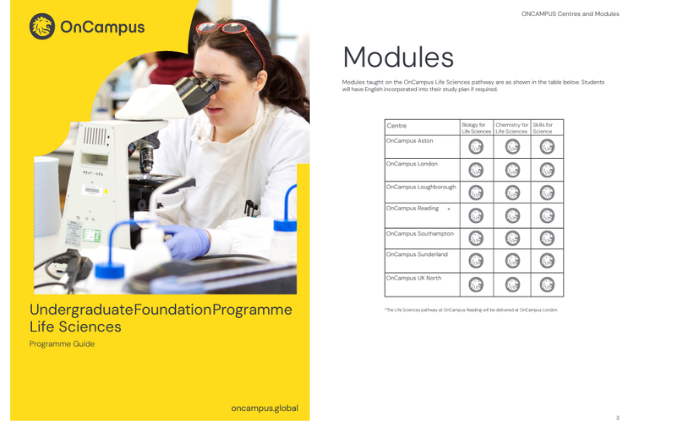
Each module will give you transferable academic skills about your subject to make sure you are well-prepared for the challenges of university study.
Read more in our detailed Module guide.
Develop your understanding of how the combination of cells, tissues and organs work together to allow organisms to live and pass on genetic information. You will gain experience of safe working practice in a laboratory setting and confidence in interpreting experimental data and observations. It gives you the opportunity to apply your knowledge to real life contexts and prepares you for future undergraduate studies within the subject area.
Read more in our Module guide.
Studying the different aspects of chemistry enables you to comprehend the combinations of physical, inorganic and organic principles. Practical work aims to complement theory and develop your observational, analytical and skills required for future scientific study.
Read more in our Module guide.
This module aims to equip you with the skills and strategies required for successful completion of your OnCampus programme and prepare you for future studies. You will gain experience in laboratory work, develop your data analysis skills and understand how to critique your findings. You will be able to draw conclusions from data, organise facts and figures in a logical way and test hypotheses. The module will also develop your ability to become an independent learner, including critical evaluation and reflective skills.
Read more in our Module guide.
Why choose OnCampus?
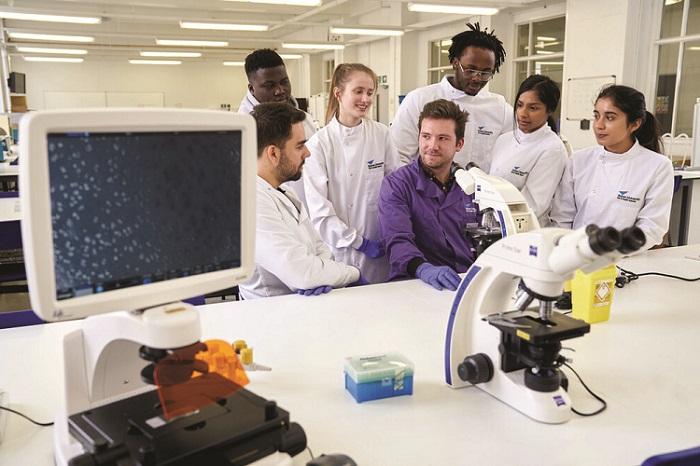
Gain understanding through practical work
Develop your English skills alongside other international students
Learn from passionate and qualified tutors

Secure your place on a high-quality university preparation programme with OnCampus today.
Our Life Sciences Partners
Life Sciences progression degrees offer international students a clear and flexible pathway into a wide range of rewarding healthcare careers. They allow students to progress into specialised areas of health practice, such as physiotherapy, radiography, sports science, nursing and more.
They provide access to high-demand global professions, strong employability prospects and the opportunity to study within healthcare systems known for high standards and extensive placement networks. Many programmes also offer clear routes to professional accreditation or registration, making them a strategic choice for students aiming to build a career abroad or return home with internationally recognised skills.
RCSI, Ireland's only specialist health sciences university, has a unique surgical heritage that is globally recognised for educational excellence and ground-breaking research. Based in Dublin, the RCSI University of Health and Life Sciences is home to Ireland's largest medical school offering degrees from Medicine to Pharmacy and Physiotherapy.
The University of Southampton is a Russell Group research-intensive university with around 25,000 students from over 130 countries, reflecting its strong international presence. It is ranked within the Top 100 universities, (QS World Rankings 2026).
A member of the prestigious Russell Group, Queen Mary ranks within the top 10% of global universities. With over 32,000 students drawn from more than 170 nationalities, around 44% of whom are from overseas. It ranks 31st in the world for research quality and 7th in the UK according to the latest THE World University Rankings.
Loughborough University is a top-tier UK university. Ranked 10th in the UK for graduate prospects and 3rd in the UK
for student experience, (Times and Sunday Times Good University Guide 2025). It ranks 7th in the UK, (Complete University Guide 2026).
University College Cork, (UCC) University College Cork (UCC) has over 24,000 students, including around 3,900 international students from more than 138 countries. It ranks among the top 250 of universities worldwide, (QS World University Rankings) and the top 1% worldwide.
The University of Galway is one of Ireland’s leading higher education institutions. Located on the scenic west coast of Ireland, in the vibrant city of Galway. Renowned for its strong commitment to academic excellence, research innovation, and community engagement. According to QS World University Rankings, they are ranked in the top 2% of universities worldwide and the top 100 universities in Europe.
Birkbeck, University of London, established in 1823, is a distinguished institution renowned for its commitment to research and teaching excellence. Ranked in the Top 300 universities, (Times Higher Education World Rankings 2025). Birkbeck is part of the prestigious University of London, one of the world’s largest and most highly regarded universities. Birkbeck is situated in Bloomsbury, the academic heart of London.
The University of Limerick (UL) is a dynamic, research-intensive university in Ireland. Known for its excellent state-of-the-art student facilities, the University of Limerick has been voted number one in the world for student experience.
Aston University has an impressive track record of exceptional teaching and research. Aston was awarded University of the Year for Graduate Employment (The Times Higher Education Awards) and is consistently ranked well for teaching quality and student experience. Aston has a large international student community from over 120 countries and courses that are designed with real-world skills in mind.
Recognised with TEF Gold for teaching excellence and holding prestigious dual accreditation from AMBA and AACSB, the University of Hull achieves consistently strong graduate employment rates from its picturesque location in East Yorkshire.
One of the UK’s Top 30 universities in the Guardian University Guide 2026, the University of Sunderland is a globally-orientated institution based on the north-east coast of the UK.. In addition the university ranked 1st in the north-east for teaching quality (The Times and Sunday Times Good University Guide, 2025). 40% of the student body is international, and represents over 120 nationalities.