

Key Benefits of Our Programme
Multiple Progression Routes: Gain access to prestigious universities, including Loughborough University, the University of Southampton, University of Amsterdam Faculty of Economics and Business, Kedge Business School and Birkbeck, University of London, with a clear pathway to your chosen degree.
Flexible Pathway Options: Start your academic journey in either the UK or Europe, experiencing vibrant university environments designed to enhance your learning and personal growth. Our pathways are tailored for international students, combining academic success with improved English language proficiency.
Broader Business Opportunities: Explore a range of related degrees, such as Accounting, Economics, Mathematics, Marketing, and Management, to discover the field that best suits your ambitions.
Study on Campus: Experience life as a university student from day one. Join a diverse, welcoming community of international students and learn on the same campus where you’ll pursue your degree, immersing yourself in the academic culture and social life.
Dedicated Support: Our expert team of personal tutors will guide you through every step of your journey, ensuring your academic and personal success.

Why study Business?
Business and related disciplines, such as economics, marketing, and management, provide an exceptional foundation for professional success.
Develop key skills in research, communication, and analysis, making you highly desirable to employers worldwide.
Gain the flexibility to pursue diverse career paths, from consultancy and management to finance, trading, and entrepreneurship.
Prepare yourself for a future of endless opportunities, equipped with the tools to thrive in competitive global markets.
Whether you're dreaming of launching your own business or stepping into a leadership role in top sectors, studying business is the perfect first step.
Learn more about the Undergraduate Foundation Programme.

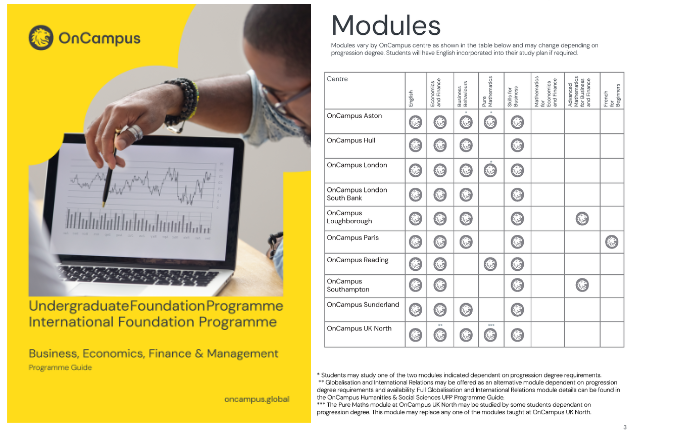
Modules you will study
Each module will give you transferable academic skills about your subject to make sure you are well-prepared for the challenges of university study.
Read more in our detailed Module guide.
You will develop a strong understanding of how economies work, both at the level of individual consumers and firms (microeconomics) and at the national and international level (macroeconomics). You will learn to interpret economic indicators, understand government policies, and analyse market dynamics. In the finance section, you will practice recording double-entry bookkeeping, preparing financial statements, and using ratio analysis to assess business performance. These skills will help you confidently analyse economic issues and financial health in your future degree.
Read more in our detailed Module guide.
You will explore how businesses operate, including the roles of managers, leaders, and stakeholders, and how external factors influence business decisions. You will learn to conduct SWOT analyses, develop marketing strategies, and understand operational and financial decision-making. You will also gain experience in organisational design and employee motivation. These skills will prepare you to analyse and solve business problems, making you a valuable contributor in group projects and case studies at university.
Read more in our detailed Module guide.
You will develop independent learning, research, and academic communication skills. You will learn how to conduct and present research, write academic papers with correct referencing, and deliver effective presentations. Reflective and critical evaluation skills are also emphasised. These competencies will be directly transferable to your university studies, where independent research, academic writing, and presentation skills are vital for success.
Read more in our detailed Module guide.
You will gain a strong mathematical foundation for analysing economic and financial problems. You will cover algebra, calculus, and statistics, learning to apply these tools to model and interpret economic and financial data. The ability to use mathematics in context will prepare you for the analytical demands of economics and finance degrees, where quantitative analysis is key.
Read more in our detailed Module guide.
Hear from our Students

Secure your place on a high-quality university preparation programme with OnCampus today.